
The Invisible Danger: Why Pool Bonding Matters
At Aquatic Artists, we truly believe that safety is not just some item on a checklist—it is the absolute foundation of everything we build. And that all starts with understanding why bonding is non-negotiable.
Your backyard has pumps, lights, and all sorts of electrical equipment running. Tiny, undetectable amounts of voltage can leak into the ground, the water, or even metal parts like a ladder. This is what the National Electrical Code (NEC) calls voltage gradients—and it is a very real hazard.
Without bonding, if you touch that ladder while standing on wet concrete, you could literally become the easiest path for that electricity to travel. That is exactly the danger we are here to prevent.
Bonding vs. Grounding: What is the Difference?
This is probably one of the biggest points of confusion, so let us clear it up:
- Grounding is for when something goes catastrophically wrong. It gives a huge surge of electricity a path to the earth to trip a breaker.
- Bonding is different—it is a preventative measure. It connects everything metallic together (the ladder, the light, the pump) so they are all on the same electrical team.
If there is no difference in voltage between them, there is no way you can get a shock. For pools, bonding is your number one line of defense.
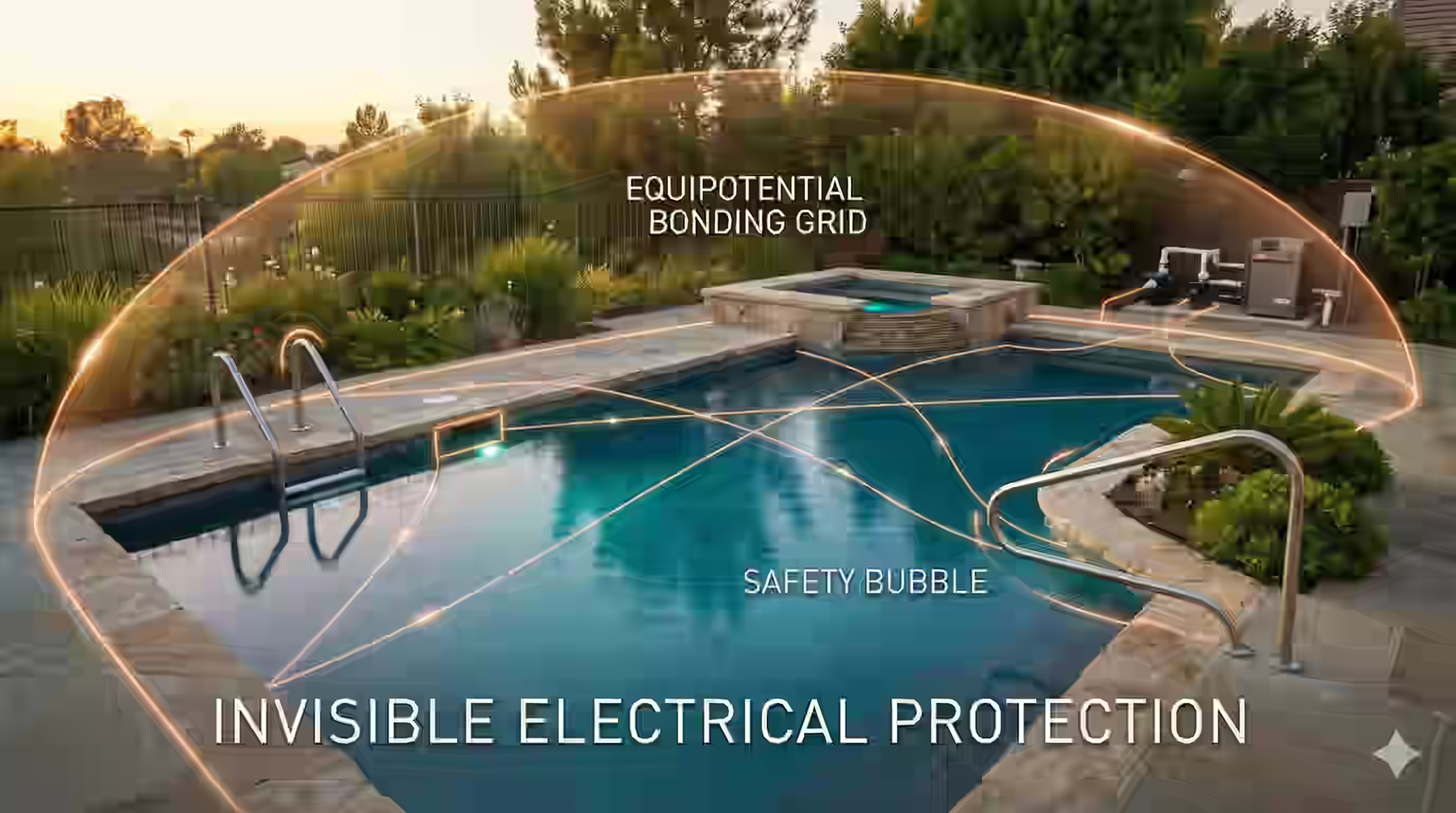
The Equipotential Grid: Your Pool’s Safety Bubble
The equipotential bonding grid is basically a web of heavy-duty bare copper wire—we are talking #8 gauge, thick stuff. Its entire job is to physically link up all the metal parts in and around your pool, putting them all at the exact same electrical potential.
Think of it this way: its mission is to create an invisible safety bubble. Inside this bubble, every single conductive surface—the water, the handrail, the wet deck—is at the same voltage. You can touch all of them at once, and because there is no difference, there is no path for electricity to travel through you.
It is an incredibly simple concept that has life-saving results.
The NEC Bonding Checklist (Section 680.26)
The National Electrical Code gives us a clear checklist of what must be connected to the safety bubble:
1. Pool Structure
- Concrete pools: All steel rebar inside the shell must be connected
- Fiberglass pools: A copper grid must be installed around the pool
- The deck surface must be bonded in a 3-foot perimeter all the way around the pool
2. Metal Parts You Can Touch
- Anchors for ladders and handrails
- Metal drain covers or fittings 4 inches or larger
- Metal frames for diving boards or slides
- Metal housing (niche) for underwater lights
Rule of thumb: If it is metal and it is part of the pool, it gets connected.
3. The 5-Foot Zone
The safety bubble extends beyond the water. Any fixed metal part within 5 feet horizontally of the inside edge of the pool must be tied into the bonding grid, including:
- Metal fences
- Aluminum window frames
- Metal downspouts
4. Equipment and Water
- Metal cases for pumps and heaters (exception for double-insulated equipment)
- The pool water itself—bonded using a special metal fitting with at least 9 square inches of surface touching the water
Pool Lighting: The Rules
Pool lighting rules are extremely specific because you have electricity and water right next to each other—there is zero room for error.
120-Volt Lights
The metal housing must be bonded to the grid. Period. No exceptions.
Low-Voltage Lights (The Exception)
Certain approved low-voltage lights do not need to be bonded—but only if they meet ALL three conditions:
- The light must be officially listed as not needing a ground
- It must operate at very low voltage (around 15 volts)
- It must be powered by a special listed isolating pool transformer
Important: This is not a loophole—it is a completely separate engineered safety system. The safety comes from the system design: that special transformer isolates the power, and the voltage is so low it simply cannot become a shock hazard.
You cannot just grab a standard landscape light and hope for the best. At Aquatic Artists, this is a zero-tolerance issue for us. We only install systems that are specifically designed and listed for this critical application.
The 5 Golden Rules for Pool Safety
Proper bonding is not an add-on or an upgrade—it is the invisible framework of safety that has to be there from day one. Remember these five key points:
- Bonding equalizes voltage to prevent shock
- #8 copper wire is the backbone of your safety bubble
- Everything within the 5-foot zone gets connected
- Low-voltage lights are a strict exception, not a shortcut
- Never assume—always check the latest code and talk to a qualified professional
Is Your Pool’s Safety Bubble Complete?
Proper electrical bonding is the silent, unseen guardian of your pool. Now that you know the rules of the game, take a second to consider: is your pool’s safety bubble complete?
If you have questions about pool bonding or want to ensure your pool meets current electrical codes, contact Aquatic Artists today.