


A few weeks back we got a call from a pool builder. He was on-site, asking about spec details for one of our waterfall systems. It was the kind of question where getting it wrong means someone orders the wrong thing and a job gets delayed. He was standing about ten feet from an excavator.
Our AI phone assistant picked up. And then, for a long moment, it could not figure out what he was saying.
It wasn’t a disaster. He called back, got a person, got the answer. But it stuck with me. Pool builders and landscape contractors don’t call from quiet offices. They call from job trailers with compressors running, from trucks on the highway, from backyards where a crew is cutting block. If your AI phone answering system can’t handle that, it’s not useful for the people you most need to reach.
That was the starting point for a round of upgrades we pushed through this month.
AI phone answering starts with better audio
The first fix was noise cancellation on the audio side. Before the AI assistant ever tries to understand what a caller is saying, the audio gets filtered. Background noise, wind, machinery, anything that’s consistent and predictable gets stripped out before transcription starts.
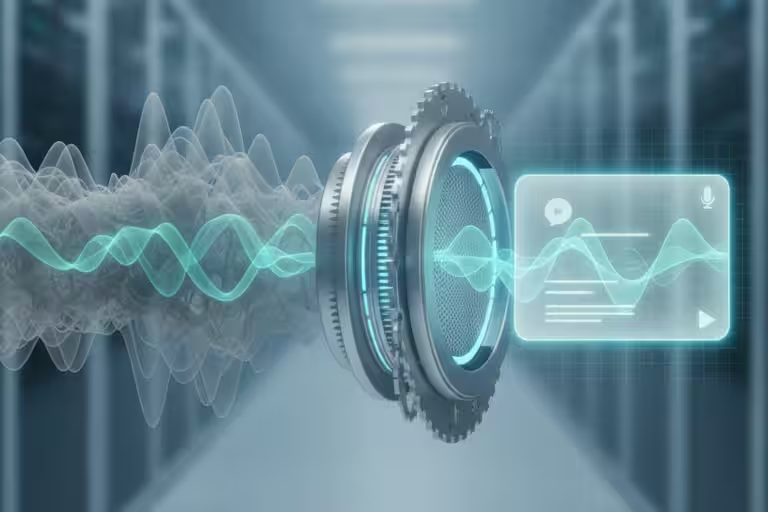
Transcription is the step where spoken audio becomes text, and it’s where most voice AI fails. Once you have clean text, the AI can actually figure out what someone wants. But if the input is half-static and half-words, the transcription is garbage and everything downstream is a guess.
We also upgraded the speech-to-text engine itself. The practical result is that the assistant handles noisy jobsite calls noticeably better. Not perfectly. A nail gun at close range is still a nail gun. But well enough that calls which were previously failing are now going through cleanly.
The key feature is knowing when to hand off
Here’s the thing about AI phone assistants that most demos don’t show you. A well-designed AI can answer a lot of common questions well: hours, pricing tiers, basic product specs, how to schedule a callback, where to find information on the website. It can take a message with the right details. It can book a time slot.
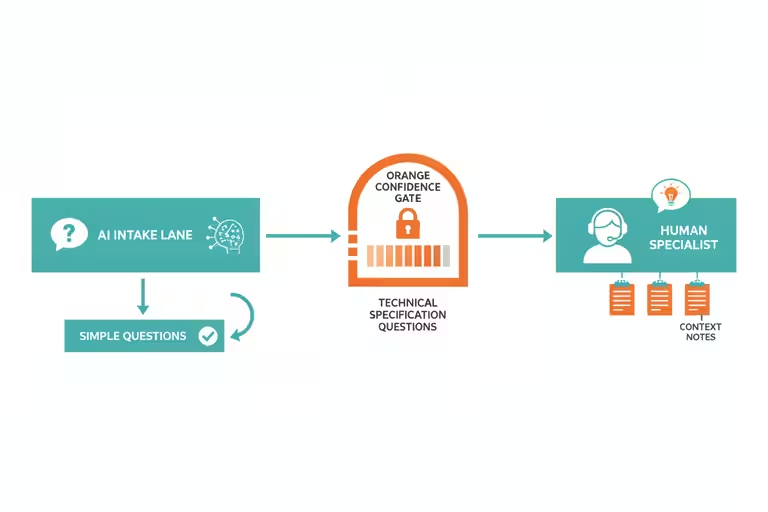
But a contractor asking a technical specification question under time pressure is a different situation. The wrong answer there doesn’t just fail to help. It actively causes a problem.
What we built is a human handoff system. The AI assistant knows its own limits. When a call goes past what it can handle confidently, like a detailed technical question, a scope-of-work discussion, or anything where a wrong answer has real consequences, it routes the call to the right person on our team, with context about what was already discussed.
The caller doesn’t start from scratch. The assistant summarizes what it captured so far, the specialist picks up mid-conversation, and the whole thing feels like one call instead of two. The AI handled what it could. A person handled what it couldn’t. Nobody guessed.
This is the part of voice AI that I think matters most for contractor businesses. The value isn’t in having a robot try to answer every question. It’s in making sure the right questions reach the right people without falling through the cracks.
Searchable meeting transcripts for contractor teams
We also wired up a separate but related piece: the conference room mic and meeting transcription. We have a small hardware setup, just a dedicated mic and a button to start recording, that captures our internal meetings and produces a speaker-labeled transcript. The AI figures out who said what based on voice patterns, and the result gets stored where anyone on the team can search it.
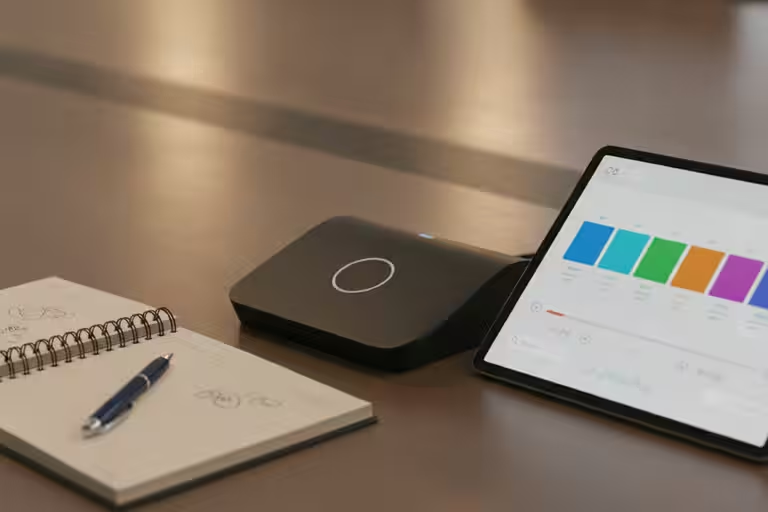
The reason this matters for a small shop is simple. We have four or five people who need to know what was decided in a meeting they didn’t attend. Before this, someone took notes. Sometimes the notes were good. Sometimes they were a few bullet points that made sense in the moment and nothing three days later. Now the full transcript is searchable, and if someone needs to find the exact thing Chuck said about the Henderson project, they can find it in about thirty seconds.
Trades and contractor businesses run on verbal decisions. Job change orders get discussed on-site and sometimes never make it to paper. Having a searchable record of what was actually said isn’t a luxury. It’s the kind of thing that prevents real disputes.
Where AI call routing is useful for the trades
If I were explaining this to another contractor, I would not start with the AI part. I would start with the missed-call part. A builder calls after hours. A homeowner calls while you are on a job site. A supplier calls with a question that needs to land with the right person. Those are real moments where work gets won, lost, or delayed.
Phone answering fits squarely in that category. A missed call from a builder who’s deciding between two waterfall vendors is a real cost. An AI answering service that picks up, gets the basic information, and either handles the question or routes it correctly, that’s the whole job.
What AI phone answering can’t fix on its own
A handoff only works if the right human is available to receive it. We set ours up with fallback routing, but there are still calls that go to voicemail because everyone is out in the field. The AI can’t conjure a person who isn’t there.
Meeting transcripts are also not perfect. The speaker identification works well most of the time but occasionally attributes a line to the wrong person, especially when two people speak at the same time or someone is remote on a phone line. We spot-check important transcripts before treating them as the record of record. They’re a first draft, not a court document.
And none of this changes the fact that for certain calls, like complex estimates, scope negotiations, or anything with a difficult customer, a person needs to handle it from the start. The AI assistant is good at coverage and triage. It’s not good at nuance, and we don’t ask it to be.
If you’re thinking about voice AI for your business, the practical test is this: call your own number from a loud location. See what happens. If the AI can’t hear you, it can’t hear your customers either. That’s the first thing to fix.